Guide
How to read a Japanese sunscreen label
Three marks do most of the work: SPF, PA and stars. Here is what stands behind each.
SPF: the UVB mark
SPF is the number most buyers know. It measures protection from sunburn, and the test behind it is the same international method in Japan and elsewhere.
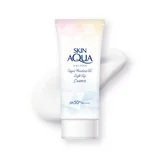
A Japanese label stops counting at 50. When the measured value is above that, the label prints SPF50+. Every Skin Aqua sunscreen here carries that mark.
“The SPF value indicates the level of sunburn protection provided by the sunscreen product.”
PA: the UVA grade
PA is the mark US buyers ask about most. It grades protection from UVA rays in plus signs, from one to four.
The grade comes from a measured UVA protection factor. The Japanese industry standard sets the steps: 2 or more earns one plus, 4 or more two, 8 or more three, and 16 or more earns all four.
Stars: water resistance
Since 2022 Japanese labels mark water resistance with stars. One star stands for a water test of 40 minutes in total, and two stars for 80 minutes.
A star is a test result, not a promise for a day at the pool. Dermatologists are blunt about the word waterproof.
“In the case of the water immersion condition of 80 minutes in total (20 minutes×4 times) If the product is determined to be water resistant, label as “UV 耐水性★★””
“In addition, keep in mind that while some sunscreens are water resistant, no sunscreen is “waterproof” or “sweatproof.””
The smaller words
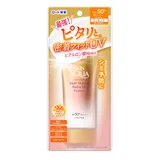
The back of a Skin Aqua pack adds short lines in Japanese. These are the ones worth knowing, with the products that print them.
| On the label | Meaning | Printed on |
|---|---|---|
| 石けんで落とせます | Washes off with soap | Light Up Essence, Super Moisture UV Gel 165 g, UV Super Moisture Gel Twin Pack |
| 顔・からだ用で、化粧下地にもオススメです | For face and body, and suggested under makeup | Super Moisture UV Gel 165 g, UV Super Moisture Gel Twin Pack |
| 無香料、無着色、鉱物油フリー、パラベンフリー | No fragrance, coloring, mineral oil or parabens | Super Moisture UV Gel 165 g |
| 化粧下地にも | Also works as a makeup base | Light Up Essence |
| フローラルミュゲの香り | Floral lily of the valley scent | Light Up Essence |
| こまめにぬりなおすこと | Reapply often | Barrier UV Essence |
What a Japanese label is not
A Japanese label is not a US label in another language. The standards behind SPF, PA and the stars are set by the Japanese cosmetics industry, and they are voluntary there.
In the United States the FDA regulates sunscreen as a drug. A tube bought from abroad follows the rules of the country it was made for, and the FDA’s advice is to read its label with that in mind.
“Although JCIA Standards are not legally binding, they are acknowledged as de facto standards by regulatory authority in Japan and should be respected in terms of consumers’ trust.”
“While some countries regulate sunscreens differently (for example, as cosmetics), in the United States, sunscreens are regulated as drugs, which means they must satisfy the safety and efficacy standards for nonprescription drug products in the United States.”
“If you purchase a sunscreen outside of the U.S., it is important to read the label to understand any potential differences between the product and U.S. products.”
Questions
In short
What do the stars mean on a Japanese sunscreen?
They mark UV water resistance: 1 star for a water test of 40 minutes in total, 2 stars for 80 minutes. The Super Moisture UV Gel 165 g carries 2.
Is PA++++ the highest UVA rating?
Yes, on a Japanese label. PA has 4 grades, and PA++++ stands for a measured UVA protection factor of 16 or more. The Barrier UV Essence prints it.
Sources
- Sunscreen: How to Help Protect Your Skin from the Sunread 10 October 2026 · U.S. Food and Drug Administration
- JCIA Standards and Related Notifications for Sun Protection Factor (SPF), UVA protection Grade (PA) and Water Resistance for UV Protectionread 10 October 2026 · Japan Cosmetic Industry Association (JCIA)
- Sunscreen FAQsread 10 October 2026 · American Academy of Dermatology
General information for shoppers, not medical advice. For questions about your skin or sun exposure, ask a doctor or pharmacist.
Keep reading
More guides
How much sunscreen you need
One ounce for a body, a teaspoon for a face.
Sunscreen by the clock
The first layer, the two-hour rule and the midday sun.
Gel or essence: which form to choose
A gel for the body, an essence for the face.